

A Technical Interview with Philippe Raybaudi: Master of Widelux Restoration

There are only a handful of technicians in the world qualified enough to service Widelux cameras, and Philippe Raybaudi is one of the masters. As a professional of camera and electronic repair since 1983, he holds the title of Maître Artisan in France, or Master Craftsman.
Raybaudi is not only a technical master of restoration for the intricate Widelux cameras, among many other models as well, but also dedicated to educating others and incorporates philosophies on the role of presence, of surrender in the process of Widelux photography. His insights and contributions are not only valuable to Widelux fans but to the photography community as a whole.

A Technical Overview & Proper Use
Can you give a bit of background on how the gears for the shutter speeds interplay with the swing-lens mechanism? An overview of how the camera works from a technical perspective.
RAYBAUDI: The principle used in the Widelux panoramic camera gearbox is a centrifugal flyweight system, but with a much more compact architecture adapted to a rotating turret movement, making it different from the classic “ball governor” design. In Widelux cameras, the turret is driven by a preloaded mainspring located above the turret assembly.
The speed is controlled by a gearbox equipped with a triple centrifugal double-flyweight system that limits and regulates the rotational speed of the turret.
The coupling between the gearbox and the turret is provided by a large gear located beneath the turret mainspring.
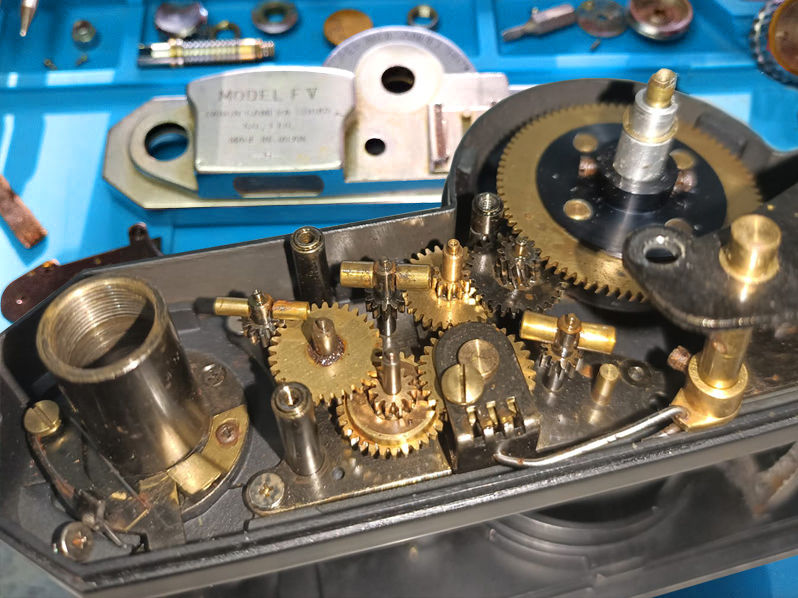
As the speed increases, six tiny flyweights (two per speed setting) pivot outward inside drums due to centrifugal force. Their outward movement increases friction (and therefore resistance) inside the drums. This braking effect maintains a roughly stable rotational speed depending on the position of the shutter speed selector.
How does improper use (changing the shutter before advancing the film, or forcing the shutter mechanism) affect the gears physically?
R: On a Widelux panoramic camera, forcing the rotating shutter speed selector is comparable to trying to change gears in a manual transmission car without pressing the clutch pedal. The gear teeth will quickly wear down or break.
The Widelux instruction manual specifically states that the turret spring must first be tensioned (in other words, the film must be advanced) before selecting a new speed.
The Widelux documentation also explains that the rotating speed selector knob does not always stop easily in line with the selected speed mark, but that the mechanism should never be forced. Instead, you simply rotate it back slightly and try engaging the desired speed again.

Because the cameras are most often bought second-hand and their histories are often unknown, how could improper use affect the camera (specifically the gears) in the long term? Is the wear something that accumulates, or is it still possible to fix?
R: Like many fully mechanical cameras, Widelux panoramic camera models are entirely repairable and will remain so indefinitely, as long as meticulous technicians are willing to learn how to service these wonderful mechanisms. The only real limitation is the cost of manufacturing replacement parts, which today are completely unavailable.
This is why Widelux cameras must always be handled gently — especially when operating the controls, which should never be forced — and why a full service every five years or so should be considered, depending on usage conditions. Regular servicing helps prevent rare and irreplaceable parts from wearing out or breaking because lubricants gradually lose their protective properties over time, even (and especially) if the camera is not used regularly.
It is also recommended to operate the Widelux at least once a month by firing it several times at all shutter speeds and by moving the aperture control, in order to prevent the lubricants from hardening due to prolonged inactivity.
Is it better to store the Widelux with the shutter mechanism wound (ready to shoot) or right after a shot is fired and before the film is advanced?
R: It is preferable to relieve the main turret spring and reduce stress on the gear teeth by storing your Widelux panoramic camera in a fired (released) state.

Common Issues
In my research online and personal experience with my F6, I’ve found a common issue to be with the slowest shutter (1/10 or 1/15)— is there a reason the gears for this shutter speed may be more prone to breaking?
R: The slowest shutter speed on Widelux panoramic camera models incorporates a fragile anti-reverse mechanism that is subjected to considerable stress from the spring motor. This mechanism is often found defective due to lack of maintenance or because the user handles the Widelux too roughly — for example during film advance. Widelux cameras are designed to be handled gently, calmly, and without force.
What are some of the most common issues you see when servicing the Wideluxes?
R: The lack of spare parts is the most significant issue, because replacement components must now be custom-manufactured. This is difficult, time-consuming, and expensive. That is why it is essential to take good care of your Widelux panoramic camera and to have it serviced regularly.
It is exactly the same as owning a vintage collector’s vehicle: if regular maintenance is neglected, sooner or later malfunctions will appear and parts will eventually break.
Are there certain issues that are easier to fix than others? When looking to buy a Widelux second-hand, are there certain issues you should test for and avoid?
R: Nothing about a Widelux panoramic camera is truly easy to repair, because they were hand-assembled and many adjustments were performed at the factory during production.
As parts wear over time, these factory adjustments tend to drift out of alignment, and it becomes very difficult to restore the original calibration.
Each Widelux is slightly different, and numerous modifications and incremental improvements were made throughout its production run. This further complicates servicing and makes manufacturing replacement parts even more challenging. The lens elements and the panoramic viewfinder optics are among the most difficult components to reproduce.
Buying a second-hand Widelux is often something of an adventure. Unless it is purchased in perfect working condition from someone who regularly uses it, it should generally be expected that it may not function properly due to long periods of inactivity and lack of maintenance. As a result, the cost of purchase often needs to include the price of a full restoration.

Different Models & Swing-Lens Cameras
In your experience, how do the gears in the Widelux differ from other swing-lens cameras (Noblex, Horizon, etc)?
R: Each swing-lens panoramic camera is different. In my view, even though they have certain design quirks that one learns to work around (such as the somewhat temperamental shutter speed selector), Widelux panoramic cameras are of a minimalist and robust, almost rustic design.
If you take care of your Widelux, it can continue to delight future generations. It is a truly durable camera.
Are certain Widelux models more serviceable than others?
R: Yes, the later F7 and F8 models of the Widelux panoramic camera feature a slightly simpler design (with fewer parts) than the earlier versions (roughly those produced before serial number 343550).

Final Thoughts
Is there anything you think people should know before purchasing a Widelux?
R: Yes, the Widelux panoramic camera forces the photographer to relinquish control in order to surrender more fully to the moment. It reveals that perfection sometimes emerges from imperfection, and that the purest beauty often appears when one stops trying to chase it.
With the Widelux, nothing is ever certain. Framing is approximate, focus is fixed and depends on the chosen aperture, and the controls are reduced to the essentials. Where a digital camera would offer absolute technical control, this film camera imposes a form of submission: you do not dominate the image, you allow it to happen.
This uncertainty is not a flaw, but a lesson. The photographer working with a Widelux learns to work with chance, to accept that randomness can become a collaborator.
Is there anything else you’d like to share about your personal journey with the Widelux?
R: Restoring a Widelux panoramic camera is an exercise in humility and patience. These cameras, often worn down by time, require meticulous attention: cleaning the optical elements of the viewfinder and the tiny lens elements, adjusting gear constraints and freeing the rotating flyweights to smooth out the shutter speeds, calibrating the sweep of the swing lens by managing friction… Every gesture must be precise, almost surgical.
But beyond the technical work, it becomes a practice of attention itself — a form of sadhana (a spiritual path) where body and mind align in a shared effort.
When you restore a Widelux, you are not only repairing a camera; you are also mending your relationship with time, precision, and frustration. And when, finally, the mechanism comes back to life — moving smoothly again with a soft, muted sound — it feels as though a part of oneself has also been restored: a recovered calm, and renewed trust in the right gesture. ◇
For more information on Widelux troubleshooting, Philippe Raybaudi's website is a wealth of knowledge, please see: https://mondepanneur.fr/widelux-troubleshooting
For an additional interview with Philippe, please see Widelux Club's interview here: https://wideluxclub.com/interview-1-philippe-raybaudi


Really cool to hear from the Godfather of Widelux! Thanks for arranging the insights!😎📸