

The Ultimate Guide to Widelux: How they Work, Different Models, Testing, and Tips for Longevity
Updated: Jun 12

The Widelux is truly one of the most mysterious cameras. Introduced in the 1950's by Panon Camera Shoko, these cameras brought swing-lens panoramic technology to handheld, portable 35mm film cameras. Only around 20,000 models were produced until the Panon Factory burned down sometime around the 2000's. All of the blueprints, equipment, and records were lost along with it.
Information on Widelux cameras remains somewhat limited and largely scattered across the internet. And when I bought my Widelux F6, a Widelux F7, and two other swing-lens cameras, all of them arrived with varying degrees of issues. Although initially disappointed, I was very quickly fascinated by this. So I researched and was also fortunate to receive some guidance from Philippe Raybaudi, one of the few masters of Widelux repair.
I compiled all the information I've received, found, and experienced into this guide to help future Widelux owners better understand these cameras and their quirks. The full video for this guide can be found here, and the full technical interview with Philippe Raybaudi here.

How Do They Work?
Widelux cameras, with their metal body and elegant design, appear very sturdy and almost indestructible. However, they are extremely delicate, particularly the mechanisms and gears inside the swing-lens system.
In a standard camera, the lens is stationary. The camera exposes the film plane all at once and from a single viewpoint, and shutter speed determines how long the shutter curtain stays open. But in a Widelux, the lens physically sweeps across the film plane, exposing the film sequentially in vertical strips. In swing-lens cameras, the shutter speed determines how fast the lens swings.
When you press the shutter, it releases the spring-loaded lens from left to right. The Widelux has 3 shutter speeds: 1/15, 1/125, and 1/250 (or 1/10, 1/100, and 1/250 depending on which model you have). Each shutter speed setting controls how fast the lens pans across the film plane (about one-fifth of a second for 1/250 versus around 4-5 seconds for 1/10).


To keep exposure consistent, a small mechanical system inside the camera regulates how quickly the lens swings. Philippe Raybaudi explains it in more detail in the interview— he explains that tiny flyweights in the system have a "braking effect" which "maintains a roughly stable rotational speed."
He also adds that the slowest shutter setting "incorporates a fragile anti-reverse mechanism that is subjected to considerable stress from the spring motor." This is why it is common for the camera to develop issues with the 1/15 or 1/10 shutter.

There are also two main things to avoid when using a Widelux:
Do not change the shutter speed until after you've advanced the film.
Do not force the shutter mechanism if it doesn't automatically engage.
The Widelux requires a very specific sequence of use for the gears to work correctly, and to ensure long-term care of the camera as a whole. This can make buying one without fully knowing its history even more risky.
Things to Know Before Purchasing a Widelux
Technical Issues
The swing-lens system is very complicated and requires considerable coordination of the internal parts. So it is extremely common for these cameras to have issues, often regardless of the condition the seller labels them as. Even if the sellers claim the cameras are "Mint condition," it is still important to do your own testing.
If an owner sells their Widelux because they no longer use it often enough, this can be an issue, as the cameras need regular use to function properly. There is also a specific, gentle way to handle these cameras, and a specific order to change the settings, which can be an issue since their full history of use is often unknown. And since these cameras have been around since the 1950's-2000's, depending on the model, this can be a long, unknown history.

Repair & CLA is Likely Needed
There's no way to know exactly what the camera's been through before it arrived at your door, so just to be safe, it may be a good idea to factor in the cost of repair and CLA. As Raybaudi mentions, "unless it is purchased in perfect working condition from someone who regularly uses it, it should generally be expected that it may not function properly due to long periods of inactivity and lack of maintenance. As a result, the cost of purchase often needs to include the price of a full restoration."
CLA and repair can range from around $200-$800 USD, depending on what the camera needs and where you take it. More on this later in the article— but even before you send it out for CLA and repairs, it is most important to perform some basic tests yourself within the return window to get a clear idea of the camera's state.

An Overview of the Widelux Models
As the Widelux cameras were produced, Panon continually updated the cameras. Raybaudi mentions, "each Widelux is slightly different, and numerous modifications and incremental improvements were made throughout its production run. This further complicates servicing and makes manufacturing replacement parts even more challenging."
All Widelux models have the same basic similarities: a 26mm lens, 3 shutter speeds, a f/2.8-f/11 aperture, fixed focus, and a swing-lens system. The overall differences between the models are noted in the table below:
Model | Year | Price (USD, 2026) | Key Differences |
Widelux FI | ~1959 | $900 - $1,800 |
|
Widelux FV | 1959 — 1960s | $800 - $1,600 |
|
Widelux FVI | ~1964 | $1,000 - $2,700 |
|
Widelux F6 | ~1970 | $1,200 - $2,000+ |
|
Widelux F6B | ~1970 | $1,300 - $2,000+ |
|
Widelux F7 | 1978 — 1979 | $1,800 - $3,000+ |
|
Widelux F8 | 1988 — 2000 | $2,500 - $4,000+ |
|
WideluxX | 2025 — Present | $4,400 new |
|
For more information on Widelux models based on serial numbers, which I also referenced to create this table, check here.

Widelux Tests After Purchasing
Visible Inspection
First and foremost, there is the visible inspection. Was the camera packed correctly— slightly overstuffed with packing material so that it doesn't move around in the box? Does the camera have any dents, scratches, or scuffs? Sometimes the camera's appearance can be telling, and sometimes, it can be deceiving. I've personally used both a scratched-up Widelux F7 that worked perfectly, and a pristine F7 where none of the photos turned out.
Test Each Shutter Speed
Next, there are a couple of technical tests to ensure the camera is functioning as it should and to assess its quality overall. These tests are best done right when you get the camera, and before you load it with film.
The first test is for the shutter speeds. Test each shutter speed (making sure to wind the advance knob first, then set the speeds). Pay attention to both how the lens moves and how it sounds. Does the lens stutter during any of the speeds? Does it move inconsistently? Do certain speeds seem to work better than others? Take note of all of these things as you notice them.


When I first received my Widelux F6, one of the first things I noticed was that the 1/10 shutter would fire inconsistently. Sometimes the lens would swing slowly (the correct speed), other times it would swing fast (similar to the 1/250 speed), and sometimes it would even start slow and speed up mid-shot. I've also seen people who receive their Widelux cameras, and the slow shutter speed won't even fire at all— or, it'll fire halfway and stop. No two Widelux cameras are the same, and they all have different histories of past use, so it's common to have vastly different experiences.

Test the Aperture
The second thing you can do is visually inspect the aperture. There are two parts to this test: to hold the camera in the light and look at the aperture from the front of the lens, and also to look through the lens directly, through the back of the camera. While testing the aperture, also check for issues with the lens itself— in either the front or rear elements: scratches, haze, dust, or other damage.
To check from the back of the lens, take off the backing, wind up the camera, set it to the slowest working shutter speed, and set the aperture to f/2.8. Look through the back of the camera and fire the shutter. You may want to point the camera at a bright background, so that you can clearly see through the opening in the lens.

Shoot a Test Roll (Before the Return Window Ends)
It is best to shoot a test roll as soon as possible, making sure you can get the negatives back before the return window ends so you can evaluate them. When purchasing a Widelux camera, it is also best to buy one with a return policy— or at the very least, the ability to return it if it is faulty or differs from the seller's description.
On the test roll, it is best to test under a variety of combinations of settings (all shutter speeds and apertures if possible) and to keep track of the settings for each shot. That way, you'll be able to recognize patterns and better diagnose a problem if it appears on only certain photos. And for this reason, you may not want to use expired film for this test, just so that you can rule out any textural problems with the film itself and avoid any unnecessary confusion.

On these rolls, you'll want to watch out for vertical banding, focus issues, and inconsistent exposures. When I ordered an F7, it arrived in pristine condition. Everything looked, and sounded, great. But once I got the test roll back, the camera's issues became clear. A majority of the photos came back blank, and on the photos that did expose, they had banding, were underexposed, and had strange textures and ghosting.
It's entirely possible that this F7 was repairable despite having these issues, but for me, it wasn't worth the price on top of what I had already paid. So I returned it. I decided to keep my F6, though, because even though the 1/10 shutter speed was firing inconsistently, it was still firing correctly at times, and the photos on the first test roll all turned out great.

Widelux shooting tip: I've had a few issues with the backing of my F6 coming open while shooting, and I've lost a few shots I've loved in the process. I notice that when kept on a body strap, the back of the camera tends to rub on your clothes, which can slowly unlock the back. For this reason, it may be good to put gaffer tape over it after locking the camera; this way, you can ensure the backing stays locked.
Another tip for rewinding: while pressing the rewind button on the bottom, pull out the rewind knob on top a little (while still engaging the film) to get a better grip. Otherwise, it will take forever, and you may end up with a blister!

A Few Common Issues
A few issues are commonly known for Widelux cameras.
Vertical Banding: Vertical banding is one of the most common issues for Widelux cameras. The smooth movement of the lens is what creates an even exposure, so vertical lines appear when the lens stutters or moves inconsistently. This is often due to lubrication issues and can usually be fixed with CLA from certified restorers of Widelux cameras. However, vertical banding can also appear when taking photos under fluorescent lights at certain shutter speeds— which is something to keep in mind for the test roll. It might be best to avoid shooting under fluorescent lights entirely to prevent confusion.

Horizontal Lines: Sometimes, thin horizontal lines appear on Widelux negatives, and a possible cause could be dust somewhere within the turret or film plane. Depending on the camera, this can sometimes be fixed by gently cleaning the film plane (where you thread the film) with a "rocket blower." Personally, I've seen this issue show up on one or two rolls and resolve itself by the next.

1/10 or 1/15 Shutter: It is common for Widelux cameras to have issues with the slowest shutter speed. As Raybaudi mentions, the slowest shutter setting "incorporates a fragile anti-reverse mechanism that is subjected to considerable stress from the spring motor." How intensive the repair may be varies by camera model and the history of use by previous owners.

Repair & CLA
After these basic tests, it is time to decide if you would like to keep the camera or return it. Sometimes, sellers are willing to pay the full or partial price of a repair or CLA if the condition of the camera does not match the description.
It is best to only send the camera to people with specialized knowledge of Widelux camera repair— otherwise, you may risk further damage to your camera. And there are only so many people truly qualified to restore Widelux cameras. Philippe Raybaudi in France is one of the masters. I contacted him when I was having problems with the 1/10 shutter on my Widelux F6, and although he no longer accepts packages from outside of Europe, he was kind enough to recommend Nippon Photoclinic in New York.
From my personal experience with Nippon Photoclinic, they were professional, responsive, and thorough. The whole process took around 3 1/2 weeks. With the gentle care and upkeep, I hope to make these repairs last. And in the next section, I will provide some of the tips I've been following when caring for my own Widelux F6.

Tips for Longevity
Here are a few of the best tips I've found and compiled on Widelux care.
Advance first, then change the shutter
Make sure the shutter speed clicks into place properly. Some advice NipponPhoto Clinic sent for long-term care was to "make sure the shutter speed dial is properly seated when choosing your speed. Sometimes, if it is not, the shutter will not fire after hitting the button, only firing when the shutter wheel is moved/re-seated."
If the shutter speed dial resists, don't force it. Instead, according to the Widelux F8 manual, "turn it to the opposite direction slightly, then try to turn it back.” Nipponphoto Clinic advised not to force any of its mechanisms in general: "while they're strong, forcing is a recipe for disaster, especially this camera's winding mechanisms."
Keep the turret protected from dust or impact— keep the camera in a case whenever possible.
Store the camera upright whenever possible, and store the aperture wide open at f/2.8 to prevent the aperture blades from sticking together.

A Few Tips From Philippe Raybaudi
In a previous blog post, I interviewed Philippe Raybaudi, one of the very few masters of Widelux restoration. He had some key tips for Widelux care. Here are some of those takeaways:
Always handle the Widelux gently— during film advance, and when operating the controls. Widelux cameras are designed to be handled gently, calmly, and without force.
Regularly exercise the Widelux, even if you're not shooting with it at the time. Operate the Widelux at least once a month by firing it several times at all shutter speeds and by moving the aperture control, in order to prevent the lubricants from hardening due to prolonged inactivity.
It is preferable to relieve the main turret spring and reduce stress on the gear teeth by storing your Widelux panoramic camera in a fired (released) state.
A full service should be considered every 5 years or so to prevent the parts from wearing out. Regular servicing helps prevent rare and irreplaceable parts from wearing out or breaking because lubricants gradually lose their protective properties over time, even (and especially) if the camera is not used regularly. It is exactly the same as owning a vintage collector’s vehicle: if regular maintenance is neglected, sooner or later malfunctions will appear and parts will eventually break.
If you take care of your Widelux, it can continue to delight future generations. It is a truly durable camera.

Conclusion: A Positive Note
The Widelux is truly a magical camera. There is nothing quite like shooting with one— from its clear viewfinder, to its unique distortion, to the way the lens physically swings with each photo. And although I've experienced a majority of issues with the Widelux and swing-lens cameras I've ordered, I also have a couple of positive notes to end on, too.
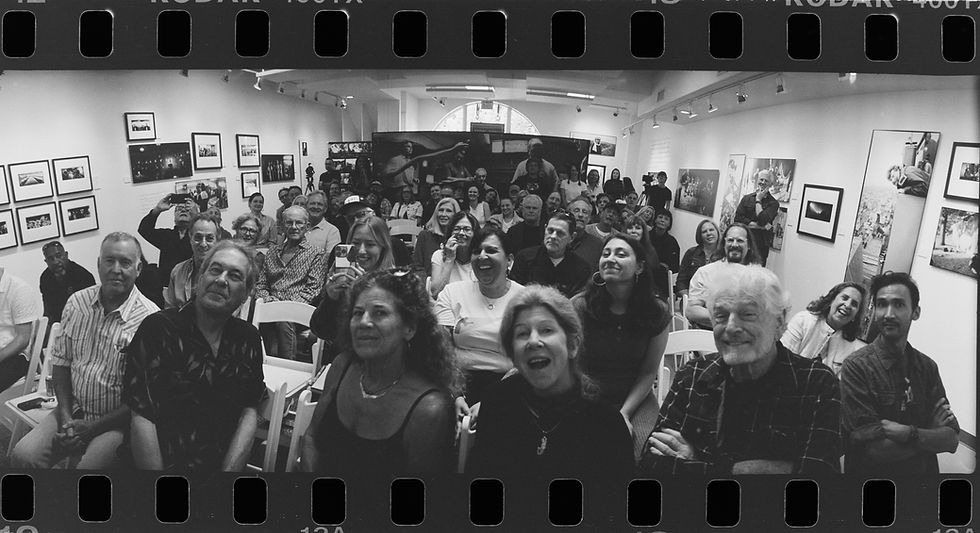
At the Jeff Bridges Photography Exhibition, I met someone who owned his F6 for 5 years and experienced no issues with the camera at all. There was something so special about seeing these cameras used in the wild, and to hear the winding and swinging lenses of Wideluxes other than my own. The love that Widelux owners have for these cameras is truly pure and heart-warming.
After repair and with regular exercise, my F6 has been working just fine. For me, all the issues I've experienced with my F6 have still been meaningful— I've gotten to learn so much more about these cameras from first-hand experience, as well as the opportunity to learn from a master of their repair. All these are things I otherwise would not have experienced if my F6 had worked perfectly from the start.
Even though the journey may not have been perfect, I wouldn't have it any other way. My Widelux F6 is truly one of my favorites, and the experience of shooting with it is unlike any other film camera I own. I hope this guide helps you feel a little less intimidated by the mysterious inner workings of these cameras. Let me know if you own a Widelux yourself or are more (or less) interested in buying one after reading. I'd love to know what you think! ◇
References for Further Research:


Comments