

Widelux: A Brief History (Early Panoramic Cameras, Hollywood Influence, & The WideluxX)
Updated: Aug 25

By Laura Odermatt
Widelux: A Brief History
The Widelux is a unique camera with an interesting history, from its complex gearing and sweeping cinematic look, to the widely known panoramic photography of Jeff Bridges.
Despite being a "specialty" camera that largely remained outside the photography mainstream (instead developing a devoted, cult-like following), this camera still earned its own special place in history. Particularly, in its relationship to filmmaking.
In order to better understand this influence, we first have to understand the history that led us to the Widelux. It may be surprising to know that the technology for panoramic cameras, swing lenses, and curved film planes dates far back, even further than the Widelux models.

Early Panoramic Cameras
The very first panoramic cameras were introduced around 1843, and they've been around almost as long as photography itself. Early panoramic photographers wanted a format that more closely resembled the expanse of human vision, photos where you could capture sweeping skylines in a single image with much more detail, rather than ones that fragmented the view ("History of Panoramic Photography").
Panoramic photography was always seen as captivating and interesting, but it was really another important invention that led to a boom in its exploration. The advent of roll film in 1888 led to swift innovations for the format and furthered its accessibility as well ("Discover the World of Panoramic Cameras..."). And roll film is much closer to the type of film we shoot on today.
Roll film was wound onto a spool and protected the negatives inside, which was much more convenient than shooting on plates that had to be prepared specifically for each photo (as was previously done). Roll film allowed for multiple exposures, for loading the camera in daylight, and it was much more portable and practical for everyday use.
Swing-Lens Panoramic Cameras
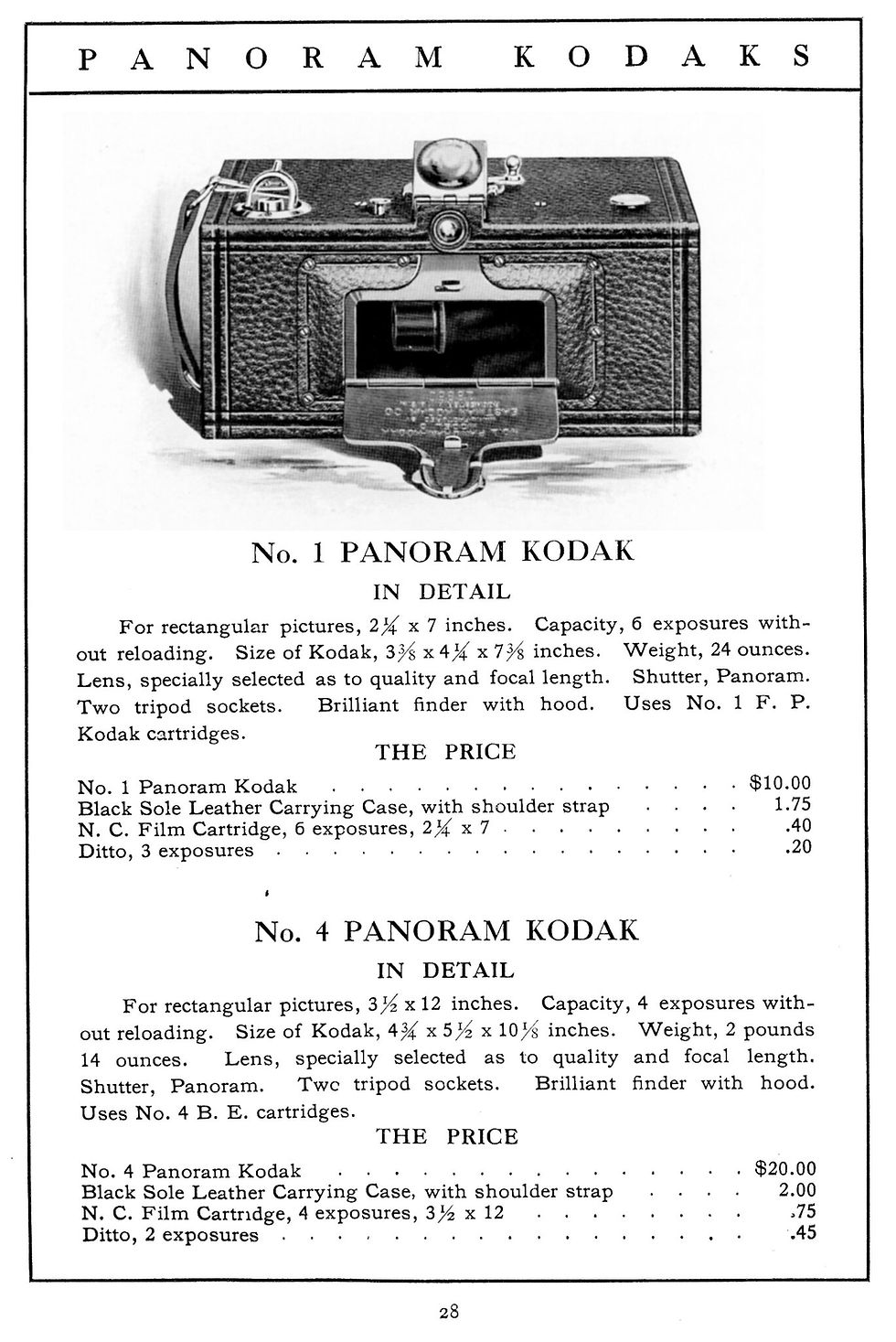
First there was the Al-Vista made in 1898, and the first commercially available swing-lens panoramic camera: the Kodak Panoram in 1899.
Designed by Frank A. Brownell (who also designed the Kodak Brownie), these cameras were revolutionary. They were the first to make panoramic photography accessible, and were used mostly for landscapes, travel, and outdoor use ("History of Kodak Panoram"). Simple and sturdy in their construction, some of these cameras are even used today.
Similar to the Widelux, the Kodak Panoram has a swing lens, a curved film plane, and a spirit level. The Panoram also only had 2 shutter speeds, and it shoots 120 film.

A Rotating Panoramic Camera
Around 1902-1905, the Cirkut camera was the first of its kind. Instead of a swing-lens system like in the Widelux, the entire camera would rotate on the tripod to capture a wide field of view.
The gears inside were synchronized to advance the film at the same speed as the moving camera, resulting in a seamless panoramic image. Due to its
size and complexity, this camera was primarily used by professionals. The Cirkut was often used for those classic long, narrow group portraits for schools, jobs, clubs, and the like. The subjects also had to be arranged in a semi-circle around the camera to appear as a straight line in the photo.

The Rise of Immersive Cinema
In the late 40's and early 1950's, television quickly gained popularity. More people chose to stay home rather than go to the movies, so Hollywood needed to come up with something that could capture attention and bring audiences back ("The Cinemascope Rebound"). This led to the invention of the wide-screen format, starting in 1952: Cinerama, Cinemascope, and VistaVision.
These wide formats were breathtaking, and the stories they told were just as grand: movies like Ben Hur (1959) and Lawrence of Arabia (1962) were just some of the early movies released in this format. From then on, going to the movies became about the experience in itself, something that televisions at home surely couldn't compete with. And audiences were hooked.

The rise of these formats gave panoramic storytelling an important context, and also a language for how we make sense of these images. Widescreen imagery became associated with spectacle, immersion, and cinematic quality— a major influence still present today, as evidenced by the fact that "cinematic" is often used to describe the sweeping Widelux images.
Conveniently, it was also just around this time that the first Widelux was invented. And although Cinemascope and other wide formats didn't necessarily directly influence production of the Widelux, they created space for the broader cultural significance of widescreen images as a whole.
Panon Camera Shoko

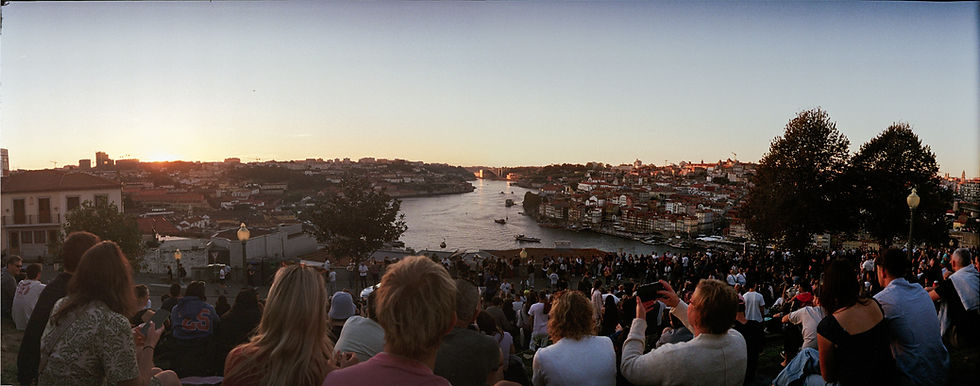
In 1952, Nakayama Shozo founded Panon Camera Shoko, and the company produced its first camera: the Panon 120. It was similar to the Widelux we know today in that it used a spring-loaded, swing-lens system. However, it shot 120 film instead of 35mm, and only took 6 shots per roll.
Interestingly enough, the response by the U.S. press was largely "underwhelming" (Panon Widelux F6"). The Widelux was an expensive, mechanically unusual camera with a signature distortion. It came at a time when Americans desired photographic realism instead; as documentary-style photography became the prevailing style in the 1950s and 1960s (The MET).

In 1958, Panon introduced the Widelux FI as
the first of the Widelux 35mm panoramic series. The 35mm Widelux models were sold exclusively in Japan until their introduction to the U.S. in the mid-60s ("Panon Widelux F6").
Following this model were the FV, FVI, F6, F6B, F7, and F8. Early models came in chrome, and it wasn't until the F6 & F6B that they also added the iconic black.
The Widelux FI, FV, and FVI had many more gear components, which also make them more difficult to service today; the F6 and subsequent models were much simpler and therefore are "generally easier to restore to working condition" ("Interview with Philippe Raybaudi," Widelux Club). For more information on how these cameras work and tips for shooting with them, watch my YouTube overview here.
Since its release, the Widelux has always been regarded as a highly niche camera, one used mainly by artists and for specialized projects. Although Americans had a context and appreciation for panoramic images in the movies, it didn't neatly translate into photography. The Widelux, for the most part, remained just outside of mainstream photography, but it undoubtedly left its own mark on history— most notably in the way it was used by filmmakers.

Widelux History: in Filmmaking
The Widelux may have been a niche oddity, but it caught the attention of a few major figures in the filmmaking world. In a way, the camera is a bit closer to and easier to understand within the context of filmmaking: it has sweeping panoramic views and the ability to capture time as an unfolding series of moments.
Jeff Bridges & his Widelux F8
Jeff Bridges famously used and popularized the F8, photographing on the sets of the movies he worked on, bringing a whole new life and context to these movies beyond the big screen. Between his striking photography and personal philosophies on the Widelux, the camera became synonymous with the actor and with moviemaking as a whole.
In the way that the lens swings over a scene at different speeds, encapsulating a collection of moments rather than one single frame, Jeff Bridges commented that the Widelux is "the bridge between still photography and moving pictures" (Jeff Bridges). From a filmmaking standpoint, not only was the camera's panoramic look appealing, but also its technical complexity and the fact that it has a place in, and even serves to connect, both worlds.
In 2013, he received the Infinity Award from the International Center of Photography for his collection of work and major contribution to photography overall. By his choice to use the Widelux and its panoramic format, he was able to transform authentic moments behind the camera into something grand and cinematic. But his photography still preserved a deeply personal feeling of warmth, of humanness. Each of his photos become their own immersive experience, echoing the very feeling of movies themselves.

Stanley Kubrick & the Widelux
Stanley Kubrick also used the camera to capture the filmmaking process behind 2001: A Space Odyssey. Photography was always a fundamental part of Kubrick's process, and he was even a photographer before he became a director. He often took production stills on set and experimented with many different cameras and tools, but for 2001, he chose to use a Widelux.
The Widelux's field of view more closely resembled the look of the film, which was shot on wide lenses on a Super Panavision 70 camera ("Widelux: A Space Odyssey"). This resulted in a cohesive feeling between the stills and the movie itself. The Widelux format captures an extraordinary amount of detail in each image, which is part of what makes these photos, especially given their place in filmmaking history, even more captivating.

The Widelux came out at the perfect time to play a brief but meaningful part in film history. Its panoramic format was visually complementary to the new Widescreen movie format, and the way that it captures a series of moments also felt familiar to filmmaking. The timing created the perfect opportunity. A space and context within which the Widelux fit effortlessly.
Widelux History: in Space
Another interesting part of Widelux history— in 1965, NASA used the Widelux on the Gemini 5 mission for the astronauts to document the journey. Given the limited room on the spacecraft, the Widelux (and its 140° field of view) was a perfect camera to capture the setup and experience in its entirety (Photographic Historical Society of New England).

The End of an Era
Panon would go on to produce about 20,000 Widelux models until the factory burned down in the early 2000s. The blueprints, equipment, and production records were all unfortunately lost in the fire.
After the factory burned down, no new Widelux models or parts were produced. For those seeking these cameras, the secondhand market was the only way to go. But because the gearing inside these cameras is so complex, and their use history is often unknown, repairs are very often required.
Widelux History Continues: the WideluxX
However, in 2023, Jeff Bridges teamed up with Silvergrain Classics to bring the Widelux back to life. They call it: the WideluxX. It is a massive project that involved totally reconstructing the camera based on the Widelux F8 model. The WideluxX is fully mechanical, handmade, and an exciting new development in Widelux history.

Conclusion
Since its inception, the Widelux has always been a surprising little camera. From its place in the history of panoramic cameras to the special relationship it has with the film industry. I'd love to know in the comments what you found most interesting, your thoughts on the new WideluxX, or even your own experience with these remarkable cameras. For now, I'll leave you with this— the Widelux is a fantastic camera not only because of its history or its technical complexity, but for the fact that it has always inspired a sense of wonder: in seeing the world a little differently, and in discovering and experiencing it wholly, unfragmented. For us Widelux fans, there is truly nothing quite like it. ◇
Widelux: A Brief History (Laura Odermatt)
Resources:
"Classic Panoramic Cameras": https://youtu.be/uSxXDXhuEFA?si=FgRhy8Jt_BZfGwQR
"No. 10 Cirkut": https://www.youtube.com/watch?v=EV5EQYtivA8
"Why Widescreen Feels Epic": https://www.youtube.com/watch?v=kUtyrSKXjNo
https://cinemontage.org/the-cinemascope-rebound/ https://mikeeckman.com/2024/02/panon-widelux-f6-1970/


Great summary! The relationship between CinemaScope and wide field photography is enlightening. Love the Widelux photos!😎📸